mental health matters
Simple Science, Stronger Selves
Executive Functions
Working Memory
Cognitive Flexibility
Inhibitory Control
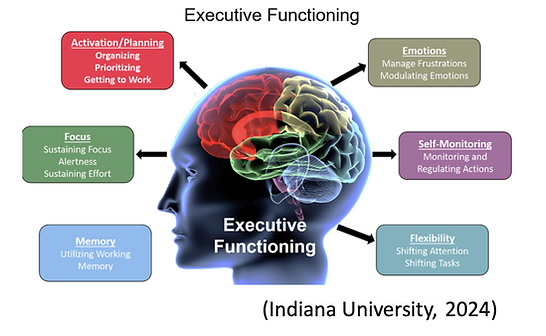
Executive functions refer to a set of higher-order cognitive processes involved in the control and organization of information to serve goal-directed behaviors. Skills in executive functioning are developed throughout childhood and adolescence and have been shown to be predictive of academic achievement
(Costello et al., 2021).
They allow us to Consciously Control Our Thoughts
Working Memory (WM)
WM enables people to maintain information that is no longer in their environment for goal-directed action
(Gomez‐Lavin, 2025)
-
How to Enhance
-
Eat a diet consisting of various micronutrients
-
A nutritious diet is crucial for good health and cognitive function, including WM (Kumar et al., 2025).
-
Study was conducted where 651 females and 530 males greater than age sixty were studied. They found that those who lacked important micronutrients in their diet had a memory performance score in the lowest quartile (Goldberg et al., 2019).
-
-
-
EX: When you remember the instructions that your GPS gives you, you're using your working memory
-
WM allows us to process stimulus and has a limited capacity "If we're not processing life, we're not living it"

Cognitive Flexibility (CF)
Ability to begin solving a problem in one way and then to shift to another strategy efficiently according to the new demands (De Santa et al., 2022).
Mental flexibility is not a passive trait; it is an actively nurtured capability, developed through intentional interventions, supportive environments, and continuous feedback (Rachmad, 2022). The academic performance of adolescents is strongly impacted by CF (De Santa et al., 2022), because it is a critical period for the maturation of brain regions that support CF (Lee et al., 2024). CF can enhance well-being, resilience, and productivity, while mitigating the stress and rigidity that often accompany change (Rachmad, 2022).
-
How to Enhance
-
Become more open to new experiences (2022)
-
Openness requires a conscious effort to move beyond habitual thought patterns, to question assumptions, and to consider alternative approaches even in scenarios where conventional strategies have previously worked. This readiness to explore the novel not only enhances problem-solving capacity but also cultivates resilience
-
-
Your environment needs to encourage experimentation and value diverse perspectives (2022)
-
Become intrinsically motivated
-
"Intrinsic motivation to learn, curiosity, and the willingness to engage with ambiguity determine the ease with which cognitive flexibility develops" (2022)
-
-
Daily self reflection (2022)
-
Journaling is a way to self reflect and has been shown to increase self efficacy (Baleghizadeh, 2014)
-
-
Cognitive training programs, Specifically:
-
Personalized one-on-one programs (mentor and mentee, teacher and student etc) (2024)
-
Including daily practices that focus specifically on the CF that you want to enhance
-
Ex: If someone is trying better their cognitive flexibility skills in math, their daily habits needs to include struggling through math while finding a route to solve the math problem
-
-
To break cognitive rigidity you must engage with the barriers that are limiting your CF (2022)
-
-
Inhibitory Control (IC)
The ability to suppress actions when they are unlikely to accomplish valuable results (Kang et al., 2022).
IC allows you to resist intrusive thoughts, prevent you from illegal decisions etc. Research suggests that mental illness such as binge eating disorder (Giel et al., 2022) and drug addictions (Ceceli et al., 2022) stem from weak inhibitory control.
-
How to Enhance
-
Engage in long term physical activity (Liang et al., 2022)
-